Showing posts with label help. Show all posts

Thursday, August 22, 2013

ADHD: THINKING OUTSIDE (& INSIDE) THE BOX

Our child with school difficulties has two essential characteristics: an exquisite sensitivity to their environment (both external and internal) and a corresponding over enthusiastic reaction to those stimuli.  Some experts believe their primary difficulty is a drive to actively seek more and more stimulating situations. They are acutely aware of what is happening around them as well as inside of them and they react quickly and strongly. They leap before they look. They are like lightning rods that instead of harmlessly conducting their white hot energy safely away into the ground instead send it back to the sky and at innocent bystanders leaving unintentional destruction and conflagration.
      We try to minimize the external stimuli by choosing a teacher who is flexible but fair, provides a consistent routine with clear rules and expectations, and immediate rewards coupled with appropriate consequences.  The teacher may sit him in front of the class, give a good deal of eye contact and tap on his desk when he is distracted. She may give him special responsibilities to keep him moving and reward his good behavior.
           At home we try to supervise his interactions with siblings and other children, provide constant discipline from both parents, and avoid wild birthday parties, violent loud cartoons or video games. Tea at his elderly great-aunt’s apartment is not going to happen.  We have seen what over stimulation can do and want to prevent the problem before it starts.  As my mother-in-law states it “You just have to nip it in the bud”.  Good advice but it is hard to catch them (if you can).
     The internal component is somewhat more difficult to get at but has the potential for greater success. We can’t completely control their outside world but we can help them learn how to manage their inner attention, hyperactivity, and impulsivity. We want our child to be less immature, to think carefully, take their time, remember to slow down and finish the job and be kind especially to small animals and stressed parents.  Psychiatrists call this process “internalization”.  As people grow older they eventually come to accept the values and customs of their culture. They become more civilized.  This is the hope and prayer of every parent.
           And so we teach our children well to behave and make the right decision. We reinforce the good behaviors by rewards and give the opposite with natural consequences.  Despite our best efforts some of our children seem to take a lot longer to learn these lessons even though they provide the multiple learning opportunities time and time again.  The frustration level for us rises quickly as the same sad scenes get replayed over and over again with diminishing returns but increasing anger, tears and guilt.
          Improvement depends on addressing both internal and external issues. My patient with a fever might lower his temperature and feel better sitting in an air-conditioned room, drinking cool water, wearing light pajamas next to a giant fan. He might finally make it to 98.6 degrees if I add some Tylenol as well. The combination of inside and outside strategies can get us back to “normal”.
          Goals to measure of therapeutic success in child with ADHD are more difficult to define. We don’t have a thermometer for that, but we have some ideas for next time.

Monday, June 3, 2013

LET THE GAMES BEGIN - ADHD and Videogames

      One example of this attention dysregulation that deserve special comment is the fascination that boys often have for video games.  One of the reasons they can play for hours is because the Nintendo demands interaction on many levels.  There is a colorful, rapid-paced animation, loud sound effects and dramatic theme music, multiple buttons and levers requiring fine motor coordination while possibly receiving jolting vibrations from the controller itself.  Add to all this a mysterious quest with seemingly endless trails and worlds to discover while being constantly rewarded with objects or new skills or weapons and the allure of games makes perfect sense.
           As we know too well, the real world is often confusing to children with ADHD and their best efforts are not rewarded.  The problem is that these games are not the real world and probably do little to prepare children for our twin goals of academic and social success.  They are addicting to us as well because our child is finally quiet and is not irritating his sister, running around the room or loudly refusing to do his homework.  As the game system develop better graphics and unlimited capability through internet connections the addiction potential multiples and more and more time and energy may be devoted to them. 
          We need to teach our children moderation in all their activities whether it be TV watching, eating, practicing or playing sports or other activities such as dance or gymnastics , or going to church or playing video games.  It may be true that the games increase fine motor coordination or self-esteem because of the “expertise” they develop but it is surely a small gain at a huge price.  There is evidence that despite their devotion to their “DS” those children with ADHD score lower than their peers because they still have deficits in attention, distractibility and impulsivity.  Let the games begin but control them with reason and let them end just as frequently.
     It is helpful to think of distractibility as a mental rather than physical hyperactivity.  It seems that these minds of these children are working just as fast as their bodies.  Thoughts come and go with blazing speed and travel on “to boldly go where no man has gone before”.  They make a thousand journeys of one step but never arrive anywhere.  They multitask but never achieve anything.  It is difficult for them to screen things out or ignore the noise around them then to focus and complete the task at hand. 
          The problem is not that they cannot pay attention, but that they pay attention to everything. They listen to the sounds outside the door, the buses going buy, the overhead lights humming or air-conditioning, the patterns in the floor and their own thoughts.  One mother recently told me that her only chance with her son was to hold his head in both hands, come down to eye level with him and slowly repeat one phrase at a time.  Even then he would take off with a new idea or observation that seemed very important to him but had little to do with the job that needed to be done.  I thought had finally reached my son when he kept the eye contact going after my heartfelt instruction but was brought back to earth when he said “Do you know I can see myself in your glasses especially when your eyes get so big when you yell?”  So much for my parenting techniques.  We want to speak the truth in love but don’t know the specifics on how to do it.

Thursday, March 7, 2013

MAKING THE RIGHT ADHD DIAGNOSIS: Using the Chief Complaint

      We will use “school and/or behavioral problems” as our chief complaint. Notice we intentionally keep the definition broad to avoid over-focusing on one cause resulting in missing other correct diagnoses.
          After seeing 5 or 6 children with fevers caused by throat swab positive strep I might be tempted to conclude that all the children with fevers I will see today will have strep and that it would obviously save time, effort, expense and pain to skip my three-step (history, physical, and lab) diagnostic process and simply start giving penicillin to everyone.  It is even easier to make this jump because we have a wonderfully effective treatment for strep and are looking for opportunities to apply it.  When one has a hammer everything begins to look like a nail. But this approach would result in over-treating the majority of children with simple viral illness and, much more seriously, missing the rare but potentially treatable case of meningitis or septicemia. 
      The most effective way for me to proceed is to define the problem at my best level of understanding.  When I enter the room with my chart in hand describing an 8 year old with a high fever of sudden onset, who I find is crying with a sore throat and lying very still on the exam table, I am already leaning towards the diagnosis of strep while trying to keep an open mind about other realistic possibilities.  All medical students are taught to develop a “differential diagnosis” to consider all the potential reasons for their patient’s symptoms.  This analogy to shifting gears is helpful in reminding us to drive ahead logically towards our diagnosis based on what we know or don’t know.  Often the facts that do not seem to fit correctly in our diagnosis might be crucial to lead us in the right direction.  We must guard against our natural tendency to sweep contradicting facts under the carpet when they do not fit into our system of understanding.  We are all guilty of that at some point.
      We now need to further clarify the initial chief complaint by asking the parents and child (and eventually the teacher) for more specifics. The parents have already written on my history form the reason they have scheduled an appointment and the results they hope to achieve.  Most often they are looking for improving for their child is grades and behaviors but also for reducing the frustration they feel in not being able to help their child.  When a child has an illness, particularly one in which the cause is unclear, the parents automatically assume it is their fault.  In the case of strep they are sure the infection was caused by letting the child go outside without a coat, forgetting their vitamins or allowing them stay up to watch a special movie.  Often there are other relatives (mother-in-laws or ex-spouses) who are quick to step in and agree with the parent’s self-assessment of blame.  In reality the source of strep is most often the classmate the child sits next to not mother (or father) failure. Similar family dynamics are associated with school problems where feelings of guilt are added to long-standing confusion and aggravation.
          The lists of chief complaints that I see include: failing to stay in a seat, not finishing school work, forgetting to hand in assignments, impulsive actions, irritability, emotional labiality, poor social skills (no friends), deteriorating relationships with parents or siblings, falling grades and lack of self-esteem.  Although it is discouraging to contemplate such a list, facing and describing the situation is the first shaky step towards correcting the problem.  The treatment phase will require transforming these concerns into goals which can then lead to a successful outcome.
      We will need to review how to obtain accurate and complete information (history) in a timely and efficient fashion. This is the ultimate goal of every medical encounter.  Next time we will begin with the four characteristics of the behaviors we must gather from our history that are essential for establishing the diagnosis for ADHD and other coexisting conditions.

Tuesday, January 8, 2013

ADHD & Dropping Out

This is an article that was published in our local newspaper The Herald Dispatch on July 12, 2012.

A few years ago I had a 16 year old teenager come to my office for help with school problems. He had been retained in Kindergarten for “immaturity”, struggled through elementary school and repeated 6th grade because of poor test scores and missing assignments. Although he was now only half-way through his freshman year in high school, his parents had been notified that he was in danger of failing again. All his grades were low and he was refusing to do his work and more than once slept at his desk. Recently, he had become argumentative with the teachers and other students and was often tardy or absent from class.
            His parents remarked that even as a young child he had always been “on the go” – “full force” they said. He often forgot the rules about staying in his seat, not talking and forgetting to raise his hand. He was a slow reader and did poorly on timed tests. In middle school his lack of organization resulted in zeros for lost papers and unexpected exams. Homework was a nightmare for everyone that could last for hours and might end in tears and threats. He was becoming very moody and was staying out later with unfamiliar and unwelcome friends. In the morning it was hard to wake him up and he would complain of being tired all day. He was thinking about dropping out of school and his parents were at the end of their rope.
            I was reminded of this patient and many others like him when I read an article in the Herald Dispatch describing a new initiative to reduce dropouts in Cabell County. A multi-disciplinary team of parents and professionals lead by Laura Gilliam and Sara Blevins of The United Way of River Cities was meeting regularly to address three basic concerns: attendance, behavior, and course performance. Although it is still unclear to me if I volunteered or was drafted, I was glad to join the Education Matters team.
            As a physician I have learned that children and adolescents with school problems usually have more than one diagnosis. They may have any combination of learning differences, emotional problems, family conflicts and Attention Deficit Hyperactivity Disorder (ADHD). Effective treatment requires finding all the diagnoses present and creating a team of education, behavior, social, and medical specialists that the family can use to help them get back on track. My expertise in ADHD is based on board certification in Neurodevelopment Disabilities and on-the-job training as a parent of two children with ADHD.  
            ADHD is a neurologic medical condition that may be present in up to 10 % of all children. The American Academy of Pediatrics has recently published evidence based guidelines for accurate diagnosis and treatment of the condition. More than 50% of children with ADHD continue through adolescence to have symptoms of hyperactivity, short attention span as well as physical, verbal, and emotional impulsivity. Children with ADHD also have an increased rate of learning disabilities causing them to struggle with reading, getting their thoughts on papers, and staying organized.    Deficits in social comprehension and problem-solving lead to difficulties making and keeping friends or maintaining good relationships with parents, teachers, and school personnel.
            Research has shown that high school students with ADHD when compared to their classmates generally have significantly lower GPAs, turn in a lower percentage of assignments and are more likely to be absent or tardy. A higher likelihood of grade retention and failure to graduate has also been documented in this group.  It is not surprising to discover that a study completed in 2011 found that the dropout rate of adolescents with ADHD was eight times greater than their age and sex matched peers.  Investigators noted that other factors independently contributing to dropping out included lower IQ, marijuana use, and decreased paternal interaction.
            What can be done to solve this complicated problem and help these teenagers? Studies across the country are showing that multi-disciplinary programs based at the local school and community level can be effective. Teachers and school administrators, agency and governmental representatives, counselors, mental health professionals, and physicians can work together to provide their special expertise. Parent leadership, however, is the key to success. North Carolina has developed a model protocol which provides the combination of education, behavioral, and medical treatment that allows these students to reach their full potential both academically and socially.
            There are happy endings. My patient’s parents obtained IQ testing for him through his school eventually resulting in an Individual Education Plan that maximized his educational strengths while providing needed modifications. Family counseling and a behavior modification system to reward correct decisions was implemented.  Medical therapy was added resulting in improved attention span and better grades. He graduated, went on to technical school, found a good job and a stable, loving relationship. 
            Education Matters, with the help and support of our community, is building a comprehensive program for these Cabell County students that can spread this kind of success to everyone.  This is an opportunity for all of us to lend a hand and get the dropout rate under control.

Saturday, December 22, 2012

PLANS VS LISTS

I am a little tired of ADHD “numbers” articles. I mean the ones that list the “7 Secrets to Improve Your Child’s Attention”, “5 Ways to Eliminate Homework Problems”, and “32 Sure Fire Steps to Save Your Marriage” (that one seems to requires a little more work). Getting ADHD under control is just not that simple. What really is needed is a system, not a list.
            Of course, lists have a place when used to remind, prioritize, and teach us. For example, one for successful brain surgery might be:
1.    Get plenty of sleep the night before.
2.    Wear comfortable shoes.
3.    Make sure your scalpel is sharp.
They may be good rules, but we expect our neurosurgeon will also have the required knowledge, experience, skills, and clinical judgment to do the job correctly. Every professional from hairdresser to plumber to policeman has a reliable plan to deal with bad hair, clogged drains and criminals. Parents too need a problem-solving process to help their ADHD child consistently achieve their best potential in school, relationships, and self-esteem.
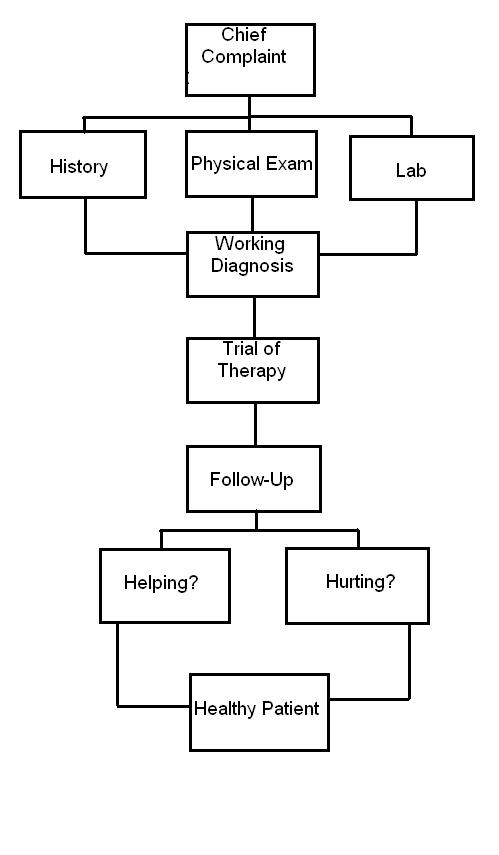
Years ago I was unexpectically given the responsibility to provide medical care for a large number of children who had ADHD and were in trouble at school. Although I had received excellent training in managing premature infants on ventilators and severely injured children in the Shock Trauma Unit, I had no idea what to do with this group. But what I discovered is that the medical problem-solving system I used to diagnosis and treat fever, pain, rash or whatever could work for ADHD as well. Although I realize this looks suspiciously like another list, I prefer to think of it as an algorithm or the sequence of steps that all doctors use to solve a problem.
1.    Describe the chief complaint (fever)
2.    Take a history (ask questions such as “Does your throat hurt?”)
3.    Do a physical exam (open your mouth and say “Ahh”)
4.    Perform a laboratory test (swab the throat and perform a rapid strep test)
5.    Make a working diagnosis (probable strep throat)
6.    Decide on best treatment ( usually penicillin)
7.    Evaluate the accuracy of your diagnosis and treatment (call the next day and ask about improvement or side effects)