Showing posts with label diagnosis. Show all posts

Thursday, August 22, 2013

ADHD: THINKING OUTSIDE (& INSIDE) THE BOX

Our child with school difficulties has two essential characteristics: an exquisite sensitivity to their environment (both external and internal) and a corresponding over enthusiastic reaction to those stimuli.  Some experts believe their primary difficulty is a drive to actively seek more and more stimulating situations. They are acutely aware of what is happening around them as well as inside of them and they react quickly and strongly. They leap before they look. They are like lightning rods that instead of harmlessly conducting their white hot energy safely away into the ground instead send it back to the sky and at innocent bystanders leaving unintentional destruction and conflagration.
      We try to minimize the external stimuli by choosing a teacher who is flexible but fair, provides a consistent routine with clear rules and expectations, and immediate rewards coupled with appropriate consequences.  The teacher may sit him in front of the class, give a good deal of eye contact and tap on his desk when he is distracted. She may give him special responsibilities to keep him moving and reward his good behavior.
           At home we try to supervise his interactions with siblings and other children, provide constant discipline from both parents, and avoid wild birthday parties, violent loud cartoons or video games. Tea at his elderly great-aunt’s apartment is not going to happen.  We have seen what over stimulation can do and want to prevent the problem before it starts.  As my mother-in-law states it “You just have to nip it in the bud”.  Good advice but it is hard to catch them (if you can).
     The internal component is somewhat more difficult to get at but has the potential for greater success. We can’t completely control their outside world but we can help them learn how to manage their inner attention, hyperactivity, and impulsivity. We want our child to be less immature, to think carefully, take their time, remember to slow down and finish the job and be kind especially to small animals and stressed parents.  Psychiatrists call this process “internalization”.  As people grow older they eventually come to accept the values and customs of their culture. They become more civilized.  This is the hope and prayer of every parent.
           And so we teach our children well to behave and make the right decision. We reinforce the good behaviors by rewards and give the opposite with natural consequences.  Despite our best efforts some of our children seem to take a lot longer to learn these lessons even though they provide the multiple learning opportunities time and time again.  The frustration level for us rises quickly as the same sad scenes get replayed over and over again with diminishing returns but increasing anger, tears and guilt.
          Improvement depends on addressing both internal and external issues. My patient with a fever might lower his temperature and feel better sitting in an air-conditioned room, drinking cool water, wearing light pajamas next to a giant fan. He might finally make it to 98.6 degrees if I add some Tylenol as well. The combination of inside and outside strategies can get us back to “normal”.
          Goals to measure of therapeutic success in child with ADHD are more difficult to define. We don’t have a thermometer for that, but we have some ideas for next time.

Friday, May 10, 2013

A DAY IN THE LIFE

The mother of my new 7 y/o patient confided to me that she simply did not believe the complaints her daughter’s 2nd grade teacher had about her classroom behavior until she decided to see for herself. The following is her verbatim list of what her daughter did over one three hour afternoon, including lunch and music class. (By the way, her teacher later commented that this had been one of her “better days”.)
  • Smacked papers hung in hallway (when her teacher got onto her, she said she didn’t do it)
  • Played with egg from desk (it was a part of a project) – 2x
  • Played with hair bow
  • Up to pencil sharpener – 3x
  • Feet not on floor – 10x
  • Dropped pencil – 3x
  • Put jacket on – 2x
  • Took jacket off – 3x
  • Not paying attention – 9x
  • Looked at book instead of listening
  • Wrote on chair and desk
  • Stood up – 18x
  • Tattled
  • Clapping hands
  • Shoes not on feet – 4x
  • Did not raise hand when teacher asked who was not allowed
  • Fingers in mouth – 3x
  • Laughing
  • Saying random words (“hun”, “mom”, “oww”) at inappropriate times
  • Skipping to the pencil sharpener
  • Asked to go to the bathroom – 3x
  • Dropped book
  • Talked out of turn – 7x
  • Dancing at desk
  • Raised hand to tell a story after teacher said “No more stories”
  • Didn’t put lunchbox up
  • Looked at reading test while teacher explained block project
  • Scooted seat across floor
  • Didn’t know what area and perimeter was even though teacher explained it 3x
  • Hitting and playing with Cameron
  • Didn’t clap to show she was paying attention
In Music Class
  • Whistling – 4x
  • Singing while the teacher was talking
  • Hit a boy
  • Hands in mouth
  • Hair in mouth
  • Yelled at boy to sit down
  • Rude to teacher (about teacher’s voice)
  • Singing after told to be quiet
  • Shouted out answer without raising hand – 3x
  • Did not sing
  • Scooted seat – 2x
  • Shoes not on foot – 3x
  • Stood up – 6x
  • Kicking feet up
  • Did not stand when told too
  • Clap hands
  • Played with friends shoe
  • Tattled
  • Sung too loud – almost to the point of screaming.
It is funny and sad and scary all at the same time. We want to keep her spark, but prevent her wildfire from spreading out of control. The only way to help her get all this under control is for parents to recruit a 3 person team of teacher-counselor-doctor to come up with treatment plans that the family coordinates for success in grades and relationships.  More on that process to follow.

Monday, April 29, 2013

GOOAAALLLSSS!!!!

During the World Cup soccer matches, a goal would always set off wild celebrations on the field and in the stands. All the team effort to kick, run, defend and block paid off in scoring a goal, increasing the likelihood of winning the game and ultimately the winner’s trophy. Setting goals is also important for parents if they expect to solve their ADHD child’s problems. We as parents basically want our children to consistently reach their best potential in school, relationships, and self esteem. Keeping these goals in mind is an important problem-solving strategy to help clarify the problem and direct the treatment.
When I see a new patient my last question for the parent is “What is your main concern?” Almost everyone correctly takes a moment to think carefully before they answer. If they have difficultly putting their thoughts into words I ask more specifically about their goals for their child or what behaviors they would like to change. I write this on the front of their chart to remind us on every visit of what our team is trying to accomplish.
I recently had a mother give me this list concerning her son. It is a heartfelt summary of the hopes we all have for our ADHD children.
1.    To know and help with what is really wrong with him, even if it is autism
2.    To sit down at a meal at home or in a restaurant with him and have him eat without arguing
3.    For him to feel safe and know he is loved
4.    For him to be able to make friends his own age
5.    For him to do well in school – academic and behavior
6.    For him to be able to sleep without nightmares or getting up so many times through the night
7.    To have one day without him misbehaving
8.    For him to listen and understand what I’m trying to explain to him
The path to successful treatment of ADHD starts when the family can begin to clearly and truthfully describe their expectations of a brighter future. The next step is to put a parent team of experts together that can work to reach that magical moment of rejoicing and screaming “GOOOAAALLL!”

Wednesday, April 17, 2013

DIAGNOSING ADHD: Looking for Distractibility, Hyperactivity and Impulsivity that are “Significantly Different” from their Peers AND Cause Impairment.

This inconvenient variability of symptoms noted in our last blog also makes it difficult to determine if the behaviors see are different from our child’s age and sex-matched classmates.  In a scientific study this would be the control or healthy comparison group.  We know from experience that all five year boys often behave differently from each other and even more remarkably from five year old girls.  Even the same child, especially our ADHD, child reacts differently from day to day or even hour to hour.  The strep throat in our febrile patient acts much more reasonably by maintaining the high temperature, sore throat, headache and stomach ache symptoms so that the diagnosis can be made and treatment begun. Persistence, severity and impairment have accomplished their mission.  But not so with ADHD.
           Furthermore we parents have a limited perspective on comparative behaviors of children.  We have only one (thankfully) 5 year old ADHD boy at home, not 10 or 20 (can you imagine?).  Our frame of reference is severely limited to my other children or less well known cousins, nephews or acquaintances. Experienced teachers, however, have spent long hours with boys and girls of the same age often for many years in different settings.  They are reliable observers who may agree that all the boys in their class are a little rowdy and restless but seem to be settling down nicely as the year goes by. These boys are responding to the teachers instruction as well as the examples and unstated expectations of their classmates to follow the rules – sit in your seat, raise your hand, stay in line, no hitting or calling names. They are becoming civilized.
           To our surprise and dismay the teacher may call us for a conference in November, or worse March, to tell us that our child   is different from his peers.  He is not at the expected level of academic success or social skills and in danger of retention. After our initial, defensive mechanism reflex of denial (not my son!) has gone we begin recognize and accept in our heart of hearts the accuracy of their assessment.  These are our exceptional children who are by definition both generally and specifically different from their peers. The most discouraging part is that we also know they have great but unrealized potential.
     The last historical criteria for judging behaviors characteristic of ADHD answers the question “So what?”.  The type of symptoms present is irrelevant unless it causes harm or impairs your child in some way. After all this is America, the land of the free.  Everyone is allowed to be themselves because everyone has different unique characteristics.  We vigorously celebrate this diversity because it has made us strong.  From a religious standpoint we are taught in church that the body of believers is made up of heads, hearts, feet and hands all working in harmony with gifts differing.  Some of us can sit still longer than others, some of us tend to listen better and react quicker, some are louder and more persistent, some are on the go from morning to night, some need to be told over and over and still don’t seem to ever get it.  But it is not a problem, a disorder or diagnosis until it hurts, the pain in failing grades and failing relationships.
          Parents understand this because is the reason they have come to my office. They have finally reached the end of their rope, a point where the pain is so great they have to take action.  This is how we all make decisions about when to seek medical assistance.  If I awaken with a slight sore throat but feel pretty good after a shower, some breakfast and a couple of Tylenol, I am grabbing my briefcase and keys and soldiering on to work.  But if I can hardly swallow and my head is killing me and I feel hot and cold at the same time I am instead pitifully pleading with my wife to drive me to the Emergency Room as fast as possible. I am in distress and pro-actively am seeking relief.

Next Blog: Turning Pain into Gain (transforming impairments into goals)

Wednesday, April 3, 2013

MAKING THE RIGHT DIAGNOSIS: CRITICAL BEHAVIORS

We are taking up again the idea of using information from parent, child, and teacher (our medical history) to build a case for the diagnosis of ADHD. Since there are no physical for drugs or laboratory test available to prove the diagnosis, we must rely on descriptions of the core behaviors of ADHD: (1) Hyperactivity (2) distractibility and (3) impulsiveness – verbal, physical, and emotional.
            The diagnosis of ADHD cannot be made unless the following conditions of those three behaviors are met:
1.   Occur over a long period of time
2.   Occur in more than one setting
3.   Significantly differ from their same age and sex peers, and
4.   Cause impairment or hurt the child                        
     Recently I saw a 9 year old girl in 2nd grade that was identified in kindergarten by her teacher with short attention span and exquisitely sensitive temperament.  She cried more easily than her classmates and seemed lost in the classroom for much of the day’s activities. Her mother agreed with the teacher’s opinions. A difference in her behavior was noted by her parents when compared to her younger brother at 6 months old and she was 2 years old. Mothers sometimes will describe the child as very active even before delivery.  They have always been on the go, driven as if by a motor, impulsive, slow to listen or remember, quick to respond and emotionally susceptible. If the child’s behavior has only recently developed it is much less likely that the cause is an inherited genetic trait or behavioral style.  Environmental circumstances such as a different teacher, new school or changes at home such as a death in the family, a new baby, divorce, a move or money problems are more likely the culprits for the worsening behavior.  Circumstances not personality have dictated the course.
     Secondly the characteristics need to be seen in more than one setting to solidify the diagnosis. The children act this way not only in the classroom setting but at home and day care, with the grandparents or babysitter, at church and Sunday School, while shopping, at the ball field, McDonalds, or a birthday party, in the car or even in (or out of) bed.  There is an unpredictable quality to their behaviors as well.  One day they may be as close to perfect as humanly possible and the next day transform into an unrecognizable monsters in the same setting with the same persons.
             At other times we may be able to predict the results of an explosive equation if the additive factors can be calculated.  If he is tired or has missed a meal, cramped up in the car for a long drive to Grandma’s party at her house full of expensive, breakable and accessible knick-knacks, and is instructed to play quietly with his evil young stepsister, we know it is only a matter of time before the inevitable screams, tears and blood happens.  The actions are related to the environment, the level of supervision and the personalities involved. Problems are often magnified if the situation is unstructured, the rules imprecise and inconsistently enforced and the child’s feelings ignored or injured.  There is some evidence that if the surroundings are not particular stimulating to these sensitive and responsive children, they will explore until they discover something interesting that keeps their attention. This extreme sensitivity to their environment and rapid, intense response of the child with ADHD creates the unpredictability that is the hallmark of the disorder.  They are consistently inconsistent all the time.
           

Thursday, March 7, 2013

MAKING THE RIGHT ADHD DIAGNOSIS: Using the Chief Complaint

      We will use “school and/or behavioral problems” as our chief complaint. Notice we intentionally keep the definition broad to avoid over-focusing on one cause resulting in missing other correct diagnoses.
          After seeing 5 or 6 children with fevers caused by throat swab positive strep I might be tempted to conclude that all the children with fevers I will see today will have strep and that it would obviously save time, effort, expense and pain to skip my three-step (history, physical, and lab) diagnostic process and simply start giving penicillin to everyone.  It is even easier to make this jump because we have a wonderfully effective treatment for strep and are looking for opportunities to apply it.  When one has a hammer everything begins to look like a nail. But this approach would result in over-treating the majority of children with simple viral illness and, much more seriously, missing the rare but potentially treatable case of meningitis or septicemia. 
      The most effective way for me to proceed is to define the problem at my best level of understanding.  When I enter the room with my chart in hand describing an 8 year old with a high fever of sudden onset, who I find is crying with a sore throat and lying very still on the exam table, I am already leaning towards the diagnosis of strep while trying to keep an open mind about other realistic possibilities.  All medical students are taught to develop a “differential diagnosis” to consider all the potential reasons for their patient’s symptoms.  This analogy to shifting gears is helpful in reminding us to drive ahead logically towards our diagnosis based on what we know or don’t know.  Often the facts that do not seem to fit correctly in our diagnosis might be crucial to lead us in the right direction.  We must guard against our natural tendency to sweep contradicting facts under the carpet when they do not fit into our system of understanding.  We are all guilty of that at some point.
      We now need to further clarify the initial chief complaint by asking the parents and child (and eventually the teacher) for more specifics. The parents have already written on my history form the reason they have scheduled an appointment and the results they hope to achieve.  Most often they are looking for improving for their child is grades and behaviors but also for reducing the frustration they feel in not being able to help their child.  When a child has an illness, particularly one in which the cause is unclear, the parents automatically assume it is their fault.  In the case of strep they are sure the infection was caused by letting the child go outside without a coat, forgetting their vitamins or allowing them stay up to watch a special movie.  Often there are other relatives (mother-in-laws or ex-spouses) who are quick to step in and agree with the parent’s self-assessment of blame.  In reality the source of strep is most often the classmate the child sits next to not mother (or father) failure. Similar family dynamics are associated with school problems where feelings of guilt are added to long-standing confusion and aggravation.
          The lists of chief complaints that I see include: failing to stay in a seat, not finishing school work, forgetting to hand in assignments, impulsive actions, irritability, emotional labiality, poor social skills (no friends), deteriorating relationships with parents or siblings, falling grades and lack of self-esteem.  Although it is discouraging to contemplate such a list, facing and describing the situation is the first shaky step towards correcting the problem.  The treatment phase will require transforming these concerns into goals which can then lead to a successful outcome.
      We will need to review how to obtain accurate and complete information (history) in a timely and efficient fashion. This is the ultimate goal of every medical encounter.  Next time we will begin with the four characteristics of the behaviors we must gather from our history that are essential for establishing the diagnosis for ADHD and other coexisting conditions.

Tuesday, February 26, 2013

ADHD - Making the Diagnosis

We need to proceed to accurately describe the two major barriers obstructing our path from chief complaint of school and behavioral problems to valid diagnosis and effective treatment.
     The first barrier to diagnosis is the pitiful lack of hard scientific evidence.  There are currently no specific physical findings or laboratory tests that we can use to help us diagnosis any behavioral problem such as ADHD, depression, anxiety or obsessive compulsive disorder.  Our vaunted medical problem-solving system that should flow from history, physical and lab test to correct diagnosis fails us miserably.  This not to say that a complete physical examination including a neurological assessment should not be performed on every child with school problems.  Certainly there may be specific labs that we may want to obtain if the physical examination suggests disorders such as anemia, lead poisoning, hyperthyroidism or fetal alcohol syndrome, Such causes of “acquired” ADHD are for the most part very rare.  Medical research is daily adding to our knowledge concerning the genetics, neuroanatomy and physiology (structure and function of the brain) associated with ADHD.  Although it is encouraging and enlightening to discover evidence supporting the existence of a brain-based disorder, none of them separately or together can be used as a gold standard for the official stamp of approval for diagnosing ADHD.  The bad news for us all is that there is no test for ADHD.
     What to do?  Actually this is a dilemma that occurs more often in medicine than physicians would like to admit.  Life and death treatment decisions must sometimes be based on our best guesses at underlying causes when there is limited supportive physical or laboratory evidence.  Asthma, for example, is not diagnosed by any specific test or sign but rather on the history that the parent and child describe.  Our confidence in our diagnosis is increased if we are able to add findings of audible wheezes heard while listening to the lungs and flattened diaphragms or hyperinflated lungs seen on chest X ray films.  We fare better in the case of the strep throat because current technology provides a rapid, reliable test for the presence of the bacteria.   Not too long ago, however, we had to wait 24 to 48 hours for our bacterial colonies on the throat swab to grow on blood agar plates incubated at 100 degrees and show a zone of growth inhibition around the bacitracin discs to prove the presence of beta-hemolytic Group A strep.  Despite these limitations we were able to immediately correctly diagnose and treat patients for strep in the “old days”. We simply had to work harder.  Without the weight of the positive strep test to confirm the diagnosis we had to gather more information to tip the balance one way or the other.  We were forced to expand our history, increase our physical findings and augment our laboratory tests to be as certain as we could be before risking definitive treatment.
     The conscientious physician would ask a lot more questions after “Does your throat hurt?”.  For instance “Do you have a headache or stomach ache? (common with strep).  How about cold symptoms or cough? (rarely associated with strep). Have you ever had an illness like this before?  Do you know what strep feels like? Have there been strep infections in your class recently?  Has anyone else been ill at home? In the same way we would look for more positive evidence from our physical examination.  We would not simply note the red throat, but we would look more closely for white or yellow exudates on the tonsils, tiny red spots or petechial rash on the roof of the mouth or a strawberry appearance on the surface of the tongue, We would palpate the neck at the angle of the jaw for the presence of enlarged and tender lymph nodes.  We would check the abdomen to see if the liver and spleen were enlarged – signs more compatible with mononucleosis.  A severely ill child with strep-associated complication of rheumatic fever might have warm swollen joints, subcutaneous nodules on the arms, unusual choreioform movements of the extremities and a heart murmur.  And although we did not have the new rapid strep test , we could order stat some more general tests that are often positive in patients with bacterial infections such as a complete blood cell count (CBC) with differential white cell percentages, erythrocyte sedimentation rates or C-reactive protein levels. 
      None of these findings prove that strep is present and causing the illness but the weight of the evidence improves the odds in our favor.  Lawyers use this strategy of building a case when they defend their client or prosecute a defendant.  This painstaking process done in partnership with families is the only sure way to develop enough data to tip the diagnostic balance in our favor and lead us to effective therapy and successful future follow-up care.  We will use this approach to navigate around the two major barriers or roadblocks on our journey to solve our children’s school and behavioral problems. Those barriers of uncertainty and complexity will next on our agenda.

Tuesday, February 5, 2013

MAKING THE RIGHT DIAGNOSIS I: DEALING WITH UNCERTAINITY

Obviously starting with the correct diagnosis is critical for our medical-problem solving system to work. If I think you have a strep throat but you really have diabetes, we are both in a lot of trouble. Doctors understand here is always some degree of uncertainty in every patient. The only physician who knows the diagnosis without a doubt is the pathologist at the autopsy—absolutely sure about everything but way too late to help. In real life we need to come up with a way to reduce the uncertainty of the diagnosis of ADHD and school problems right now.
Physicians use evidence from the history, physical and lab test to build a case for the most likely diagnosis. If you say that your throat hurts, your tonsils are big and red, and your throat culture is positive, the probability that you have a strep throat is high. You will be given a prescription for penicillin with instructions to call back tomorrow to check for improvement or side effects. Our working diagnosis is like a three-legged stool that securely rests on history, physical and lab results. The problem with behavioral diagnoses such as ADHD is that there are no positive physical findings or test. There should be because we know that ADHD is more strongly inherited even than height. Research evidence is accumulating towards specific ADHD genetic patterns, MRI findings and neurotransmitter brain levels that someday will help us nail the diagnosis—but not yet.
Before we give up and throw away our shaky one-legged diagnosis stool, we need to consider how we might strength it. If we could expand the history to form a rock-solid post, it might be able to hold a circus elephant. The diagnosis of ADHD requires a complete history from the child or adolescent, the parent as well as the teacher. Specific behavior patterns need to be looked for and then compared to same-age children using standardized questionnaires.


It is possible to make the diagnosis of ADHD and start safe, effective educational, behavioral, and medical treatment. Parents can do this. Next up, dealing with complexity.

Saturday, December 22, 2012

PLANS VS LISTS

I am a little tired of ADHD “numbers” articles. I mean the ones that list the “7 Secrets to Improve Your Child’s Attention”, “5 Ways to Eliminate Homework Problems”, and “32 Sure Fire Steps to Save Your Marriage” (that one seems to requires a little more work). Getting ADHD under control is just not that simple. What really is needed is a system, not a list.
            Of course, lists have a place when used to remind, prioritize, and teach us. For example, one for successful brain surgery might be:
1.    Get plenty of sleep the night before.
2.    Wear comfortable shoes.
3.    Make sure your scalpel is sharp.
They may be good rules, but we expect our neurosurgeon will also have the required knowledge, experience, skills, and clinical judgment to do the job correctly. Every professional from hairdresser to plumber to policeman has a reliable plan to deal with bad hair, clogged drains and criminals. Parents too need a problem-solving process to help their ADHD child consistently achieve their best potential in school, relationships, and self-esteem.
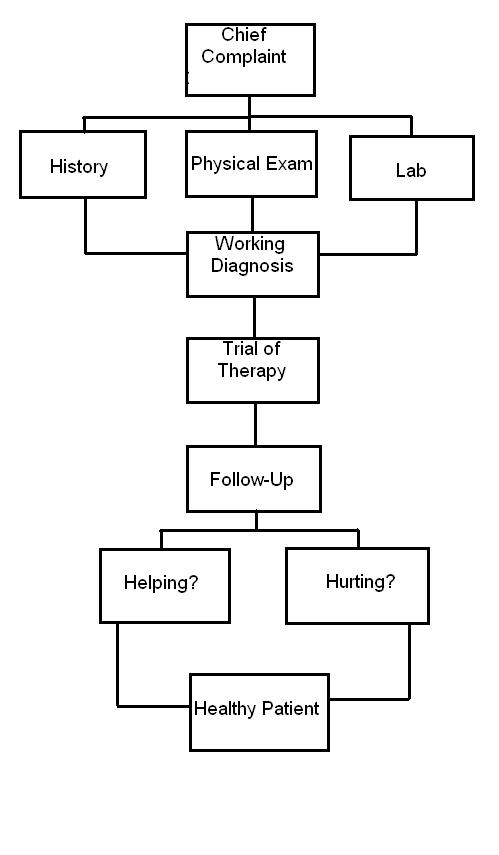
Years ago I was unexpectically given the responsibility to provide medical care for a large number of children who had ADHD and were in trouble at school. Although I had received excellent training in managing premature infants on ventilators and severely injured children in the Shock Trauma Unit, I had no idea what to do with this group. But what I discovered is that the medical problem-solving system I used to diagnosis and treat fever, pain, rash or whatever could work for ADHD as well. Although I realize this looks suspiciously like another list, I prefer to think of it as an algorithm or the sequence of steps that all doctors use to solve a problem.
1.    Describe the chief complaint (fever)
2.    Take a history (ask questions such as “Does your throat hurt?”)
3.    Do a physical exam (open your mouth and say “Ahh”)
4.    Perform a laboratory test (swab the throat and perform a rapid strep test)
5.    Make a working diagnosis (probable strep throat)
6.    Decide on best treatment ( usually penicillin)
7.    Evaluate the accuracy of your diagnosis and treatment (call the next day and ask about improvement or side effects)